Sourcing Baggy Cargo Pants Women in 2026 requires more than copying a loose silhouette. Buyers must examine fabric recovery, pocket placement, size grading, and production consistency. A pair may look relaxed on a mood board, yet feel stiff, heavy, or awkward on the body. That gap can quietly damage returns and repeat sales.
Market signals support a careful approach. McKinsey’s The State of Fashion 2025 describes a low-growth environment, making product differentiation and disciplined inventory more important. ThredUp’s 2025 Resale Report projects the global secondhand apparel market to reach approximately $367 billion by 2029. This suggests that durability, repairability, and resale value deserve attention during supplier screening. The trend is promising. The numbers do not guarantee success.
Fashion sustainability advocate Orsola de Castro has stated, “The most sustainable garment is the one already in your wardrobe.” Her point matters for Baggy Cargo Pants Women: sourcing should prioritize long wear, not merely fast visual impact. Ask suppliers for fabric composition, shrinkage results, colorfastness records, and finished measurements. Request physical samples. Test the waistband after repeated movement. Check whether cargo pockets sag when filled.
There is no perfect sourcing formula. Even a strong sample can fail in a different production batch. Smaller labels may need fewer colorways and tighter inspections. Larger retailers may negotiate better prices, but excess stock remains expensive. This guide explores practical supplier selection, cost control, quality checks, and responsible purchasing decisions for the 2026 market.
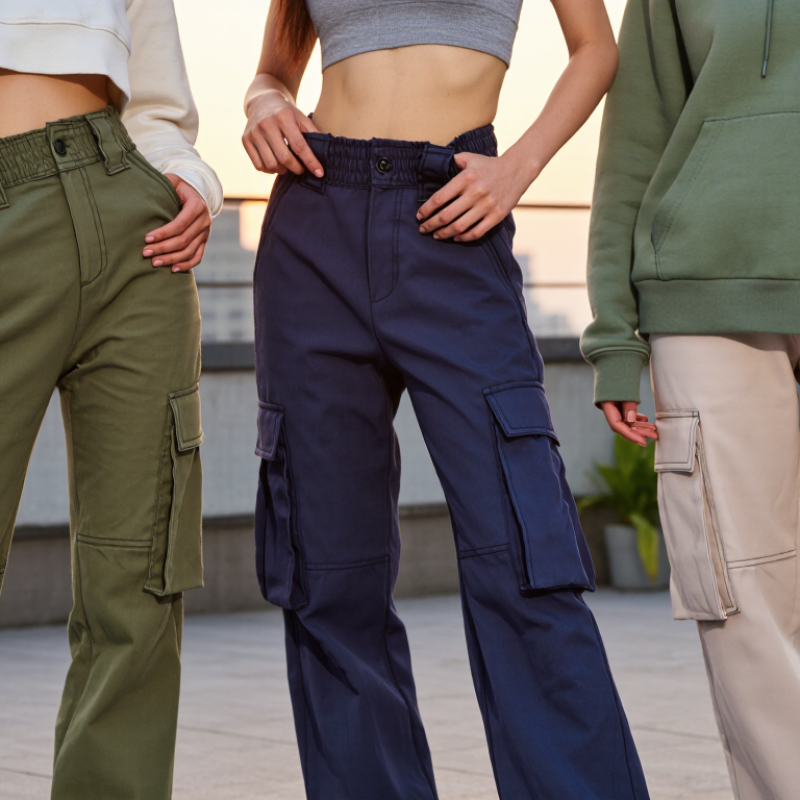
Sourcing women’s baggy cargo pants in 2026 starts with a precise fit brief. “Baggy” should not mean shapeless. Measure the waistband, rise, hip ease, thigh width, knee position, and hem opening separately. A practical sample needs room for movement, but it should not collapse under its own volume. Test the pants while sitting, climbing stairs, and carrying a phone. Small details matter.
Fabric defines the customer’s daily experience. Textile Exchange’s Materials Market Report 2024 estimates global fiber production reached 124 million tonnes in 2023. It may reach 160 million tonnes by 2030. This pressure makes fiber selection more important. Compare cotton twill, cotton-rich blends, recycled synthetics, and lighter ripstop fabrics. Record fabric weight, abrasion resistance, shrinkage, colorfastness, and drying time. Soft fabric feels attractive. It may fail at the pocket edge.
Function should be tested, not assumed. Use flat cargo pockets with secure closures and enough depth for a phone, keys, or a small wallet. Avoid excessive hardware. It adds weight and can distort the silhouette. Pocket placement must follow the body’s movement. A pocket that looks balanced on a mannequin may pull sideways during walking. My own sampling mistake would be trusting appearance before wear testing. No measurement sheet is perfect. Request wash-test results, supplier certifications, and production tolerances before placing an order. A two-centimeter error can change the entire fit.
How to Source Baggy Cargo Pants for Women in 2026?
Reliable sourcing begins with measurable production evidence, not polished showroom samples. The Textile Exchange Materials Market Report 2024 recorded 124 million tonnes of global fiber production in 2023. It also projects growth toward 160 million tonnes by 2030. This pressure makes traceability and material planning essential. Ask suppliers for fiber content records, fabric test reports, and documented subcontracting details.
Request a production walkthrough, even by live video. Check whether the factory owns cutting tables, bartack machines, pocket presses, and industrial washing equipment. Baggy cargo pants need accurate pocket placement and stable seam strength. Review monthly capacity, minimum order quantity, line efficiency, and peak-season lead times. A supplier claiming 50,000 pieces monthly should show line plans and recent output records. Numbers need proof.
Use a small pilot order before committing. Test shrinkage, colorfastness, waistband recovery, zipper performance, and pocket loading. For a heavy twill style, inspect fabric weight after washing, not only before production. The State of Fashion 2025 report from McKinsey and The Business of Fashion describes a low-growth market with continued supply-chain uncertainty. That makes flexible factories more valuable than the cheapest quotation. My early mistake was trusting certificates without checking daily controls. Certification helps, but it cannot replace factory visits, independent testing, and clear corrective-action records. Some evaluations remain incomplete. That is uncomfortable, but useful.
How to Source Baggy Cargo Pants for Women in 2026?
For women’s baggy cargo pants in 2026, sourcing should begin with physical samples, not photos. Request one standard sample in cotton twill and one revised sample with your preferred fabric. Check rise height, thigh ease, pocket placement, zipper movement, and leg drape on a real fit model. Measure after washing, because two centimeters of shrinkage can change the silhouette. Keep a measurement sheet with photos and dated comments. Small details matter.
Customization usually covers fabric weight, dye shade, waistband construction, pocket volume, hardware, labels, and grading. Ask whether pattern changes require a separate fee. A supplier may accept a new pocket shape but reject a complex waistband at the quoted price. My early mistake was approving color from a screen. It looked warmer under store lighting. Request lab dips or fabric swatches, then test them under daylight and indoor light. Leave room for one correction round.
Compare pricing by separating fabric, sewing, trims, packaging, sampling, and transport. A low unit price can hide expensive development charges. For small launches, ask about minimum orders per color and size, not only total quantity. A 300-piece minimum may become 900 pieces across three colors. Confirm payment stages, lead times, and replacement terms for defective garments. Keep written approvals. Numbers can still shift after final fabric confirmation, so an 8–12 percent contingency is sensible, though not perfect.
When sourcing women’s baggy cargo pants in 2026, quality checks should begin with the fabric roll. Textile Exchange’s 2024 Materials Market Report recorded 124 million tonnes of global fiber production in 2023. That volume makes traceability increasingly important. Request fiber-content records, colorfastness results, and shrinkage tests before approving bulk production. I also inspect pocket corners, belt loops, and bar-tacks by hand. Loose stitching often appears after repeated movement. An AQL inspection, supported by ISO 2859-1 sampling procedures, can identify defects before shipment. Still, sampling is not perfect.
Sizing accuracy needs a physical fitting process. Measure the waistband, rise, inseam, thigh, and leg opening on several production samples. Test movement while sitting, walking, and carrying a phone. Baggy silhouettes can hide inconsistent grading. A two-centimeter difference at the waist may feel minor on paper, but it changes comfort noticeably. Create a tolerance chart and record every revision. I have found digital measurements useful, yet they cannot replace real-body fittings. That remains a weakness in many sourcing workflows.
Ethical manufacturing requires evidence beyond a polished supplier presentation. The Fashion Transparency Index 2023 assessed 250 major fashion companies and reported an average disclosure score of only 26 percent. Ask for recent workplace audit reports, wage policies, working-hour records, and subcontractor lists. Check whether workers can report concerns safely. Certifications may support verification, but they are not automatic proof of fair treatment. A factory can pass one audit and still need closer monitoring. Keep dated records, interview notes, and corrective-action deadlines for each supplier.
| Verification Area | What to Check | Suggested Evidence or Test | Practical Acceptance Criteria | Recommended Timing |
|---|---|---|---|---|
| Fabric composition | Confirm the actual fiber content of the shell fabric, pocketing, lining, and trims. | Independent fiber-composition laboratory report and production-batch comparison. | Reported composition matches the approved specification and applicable fiber-labeling rules in the target market. | Before bulk approval and during random production inspection. |
| Colorfastness | Check resistance to washing, rubbing, perspiration, and light exposure, especially for dark or garment-dyed cargo pants. | Colorfastness reports using applicable ISO or AATCC test methods, with the test conditions recorded. | Results meet the buyer’s written minimum grade for each use case; no visible unacceptable transfer onto light garments. | Lab-dip approval, pre-production, and after any dye or wash-process change. |
| Dimensional stability | Measure shrinkage or growth after the care process stated on the garment label. | Pre-wash and post-wash measurements following ISO 6330 washing procedures and ISO 5077 dimensional-change evaluation, where applicable. | Within the approved tech-pack tolerance for waist, inseam, rise, and leg opening; the tolerance must be agreed before production. | Before size-set approval and during final inspection. |
| Seam and construction strength | Inspect crotch seams, seat seams, belt loops, pocket openings, cargo-pocket corners, and waistband attachment. | Seam-strength testing based on ASTM D1683 or an equivalent method, plus visual workmanship inspection. | No skipped stitches, open seams, raw edges, or bar-tack failures; strength requirement is defined in the purchase specification. | Prototype, size set, pre-production, and final random inspection. |
| Hardware and trims | Check zipper function, snap security, button attachment, sharp edges, corrosion risk, and trim color consistency. | Pull-test records, functional testing, nickel or restricted-substance documentation where required, and sample comparison. | All hardware operates smoothly, remains securely attached, and complies with the target market’s restricted-substance requirements. | Trim approval, pre-production, and final inspection. |
| Garment safety and chemical control | Review substances that may be restricted in the destination market, including certain dyes, finishes, phthalates, formaldehyde, and heavy metals. | Current restricted-substance test report matched to the actual fabric, trims, and production facility. | Passes the buyer’s restricted-substance list and all mandatory requirements applicable to the destination market. | Before bulk production and whenever materials or chemical processes change. |
| Size-chart accuracy | Compare the approved size chart with the physical garment at waist, hip, front rise, back rise, inseam, thigh, knee, and leg opening. | A measurement worksheet using a defined flat-measurement method, garment condition, and measuring points. | Every point falls within the pre-approved point-of-measure tolerance; do not rely on generic industry tolerances. | Prototype, graded size set, pre-production, and final random inspection. |
| Baggy silhouette consistency | Verify ease distribution, low or standard waist placement, rise depth, thigh volume, knee width, and leg opening across the size range. | Fit review on multiple representative body sizes, supported by front, side, and back photographs. | The intended relaxed shape is maintained without excessive twisting, drag lines, pocket distortion, or restricted movement. | During fit approval and after grading changes. |
| Care-label accuracy | Ensure washing, drying, ironing, fiber content, and country-of-origin information match the tested garment. | Label artwork approval, fiber report, care-process validation, and destination-market compliance review. | Instructions are clear, durable, attached correctly, and consistent with actual performance after care testing. | Before packaging approval and before shipment. |
| Worker health and safety | Assess machine guarding, fire safety, emergency exits, chemical storage, personal protective equipment, and accident records. | Recent independent social audit, corrective-action plan, worker interviews, and facility documentation. | No critical unresolved findings; corrective actions have owners, deadlines, and documented follow-up. | Before supplier approval and at defined periodic intervals. |
| Wages and working hours | Review payroll records, working-hour records, overtime payments, recruitment fees, and worker grievance channels. | Social-compliance audit with confidential worker interviews and payroll sampling covering peak and ordinary periods. | Pay and hours comply with applicable law and the buyer’s code; no forced labor indicators or unauthorized recruitment fees. | Before onboarding and through recurring monitoring. |
| Ethical-manufacturing verification | Confirm whether the facility has a current third-party social certification or audit, and identify the exact production site covered. | Valid certificate or audit report, scope, expiry date, facility address, audit grade, and corrective-action records. | Evidence is current, independently verifiable, and covers the facility actually making the order; an audit is not automatically a certification. | Supplier qualification and annual or risk-based re-verification. |
| Organic or recycled-material claims | Validate claims such as organic cotton, recycled polyester, or recycled nylon from fiber origin through finished garment. | Transaction certificate or chain-of-custody documentation under the relevant voluntary standard, where a claim is made. | Claim wording matches the certified scope and percentage; unsupported sustainability language is rejected. | Before marketing approval and for every applicable shipment. |
| Traceability and subcontracting | Map spinning, weaving or knitting, dyeing, cutting, sewing, washing, finishing, and packing locations. | Supplier disclosure form, approved-facility list, purchase-order traceability, and written subcontractor authorization. | No undisclosed production site; all high-risk processes are identified and subject to the same compliance requirements. | Before order placement and whenever the production route changes. |
| Final quality-control sampling | Review appearance, measurements, workmanship, packaging, labeling, and carton quantities before release. | Documented inspection using an agreed sampling plan, defect classification, photographs, and signed corrective-action records. | Shipment is released only when critical defects are absent and major or minor defects remain within the agreed limits. | Before shipment and before payment balance, where contract terms allow. |

Sourcing begins with a clear purchasing plan. McKinsey’s State of Fashion 2025 projects only 2–4% global fashion growth. That modest outlook demands careful buying. Test two or three fits before placing larger orders. Measure waist recovery, pocket strength, inseam balance, and fabric weight. A 260–300 GSM cotton blend can support structure without feeling rigid. Request size-set samples, wash tests, and colorfastness records. Do not trust a digital sample completely. I have seen attractive prototypes fail after one warm wash.
Shipping needs equal attention. UNCTAD’s Review of Maritime Transport 2024 states that shipping carries over 80% of global trade by volume. Confirm production dates, carton dimensions, loading ports, and backup routes. Ocean freight usually lowers unit costs, but delays can damage seasonal launches. Air freight protects timing, though margins may suffer. Build a realistic buffer, not an optimistic promise. Track every handoff with documented milestones.
Inventory planning should connect directly with supplier relationships. Use small initial orders, then reorder proven colors and sizes. Keep extra stock for popular waist measurements, but avoid overbuying extreme colors. Review sell-through weekly. Share forecast changes with suppliers early. Clear tech packs reduce revisions and sampling waste. Fair payment terms also encourage better communication. Still, relationships require verification. Audit records, inspect shipments, and compare delivered measurements against approved samples. My own weakness is relying too heavily on one dependable factory. That feels efficient. It is also risky. Competent sourcing needs trust, evidence, and a workable second option.